Duck chess: rules, worked examples and where to play
Duck chess is chess with a shared rubber duck. After every move, the player must also move the duck to any empty square. Pieces can't land on or pass through the duck, and knights jump it. There is no check: you win by capturing the king.
The boards below teach the rules, and the play links take you to a game site. Start with PyChess to play the computer, or Chess.com to challenge a friend.
Duck chess rules: one move, then move the duck
Duck chess is standard chess with one extra object. Set up and move as usual. Both players share one rubber duck, which sits on a square and blocks it. After your move, you must move the duck to a different empty square.
Every turn is two actions. Make a normal chess move, then move the duck to any empty square. The duck has to move: it can't stay where it was.
The duck is a wall. No piece can land on the duck's square or pass through it, and the duck can't be captured. Knights jump over it like they jump over any piece.
There is no check. A move can leave your king attacked, and a king can step onto an attacked square. Nobody is checkmated. If your king is attacked, your move or your duck has to stop the capture.
You win by capturing the king. When it's your turn and the enemy king is on a square you can reach, take it. The game ends there.
Castling still works. The king and rook must not have moved, and the squares between them must be empty. Check rules are gone, so the king can castle out of, through or into an attacked square. A duck between them blocks it.
No move at all is a win. A player who has no possible move wins at once. Chess.com says "the stalemated player wins", and the inventor calls it fowling. It almost never happens, because a king can step onto an attacked square.
A turn is written move@square. Qxh7@g5 is a queen capture on h7 followed by the duck on g5. There is no symbol for check or checkmate.
Invented in 2016. Dr. Tim Paulden, president of Exeter Chess Club in England, invented it in early 2016. It spread in October 2022 after Chess.com added it.
Each board is a teaching position with White at the bottom. The yellow duck is the shared blocker, and green squares show what to look at. A turn is written move@square, so Nc3@e4 is a knight move to c3 followed by the duck on e4.
1. The duck blocks lines, and a knight jumps over it
White's bishop on b2 and knight on f3 both attack Black's queen on d4. Black has parked the duck on c3, which cuts the bishop's diagonal, so Bxd4 is impossible. The knight doesn't need a line, so Nxd4 still wins the queen. With the duck on e3 instead, both captures are on.
Duck on c3 · White to move
The duck stands between the bishop and the queen. The knight on f3 attacks d4 without a line, so only Nxd4 works.
Duck on e3 instead
The diagonal from b2 is open, so Bxd4 is back. The duck on e3 touches neither capture.
2. Block an attack on your king with the duck
Black's rook on e8 attacks White's king on e1 down the open e-file. In ordinary chess that's check, and the move itself has to answer it. In Duck chess White can play any move, here Nc3, and let the duck do the work. Any of six squares, e2 to e7, stops Rxe1. Put the duck anywhere else and Black takes the king.
Before · the rook attacks the king
White to move. The e-file is open from e8 to e1, and the duck on h3 isn't in the way.
After · White plays Nc3@e4
Any green square works for the duck. Black's rook can't reach e1, and Black must move the duck again after their own move.
3. Put the duck on the fork square
Black's knight on d4 is one jump from c2, a square that attacks White's king on e1 and rook on a1 at once. White doesn't need to move either one. White plays a quiet move, g3, and parks the duck on c2. Nothing can land there, so the fork can't happen.
Before · a fork is one jump away
White to move. From c2 the knight would attack the king on e1 and the rook on a1.
After · White plays g3@c2
The knight has no way onto c2 and nothing else attacks the king.
4. Win a piece by blocking its defender
Black's knight on d5 looks safe, because the queen on d8 guards it down the d-file. White takes it anyway with Qxd5 and puts the duck on d6. The queen can't see d5 through the duck, so nothing recaptures. The duck on d7 works too. Put it anywhere else and Black takes the white queen back.
Before · the knight is guarded
White to move. The queen on d1 attacks d5, and the queen on d8 guards it.
After · White plays Qxd5@d6
Only d6 and d7 stop the recapture. White has won a knight for nothing.
5. A king capture the duck can't stop
White's king on h1 is boxed in by its own rook and pawns, and Black's knight on f2 attacks it. The duck stops pieces on lines, and a knight's jump has no line to stop. No White move captures the knight, and the king has no square. All 570 combinations of a White move and a duck square (10 moves, 57 empty squares each) allow Nxh1.
Before · a knight attacks the boxed-in king
White to move. Any move, with the duck anywhere, and Black captures the king.
After · Rd1@a8, then Nxh1
The knight takes the king. This is the smothered mate that strong players call a favorite pattern.
Play Duck chess online: where to start
Play the computerPyChess.orgpychess.orgIn Play with AI, pick Duck and set an A.I. Level from 0 to 8.Visit
Challenge a friendChess.comchess.comOn the Variants page, pick Duck Chess, choose a time control and enter your friend's username. They have to be online on that page.Visit
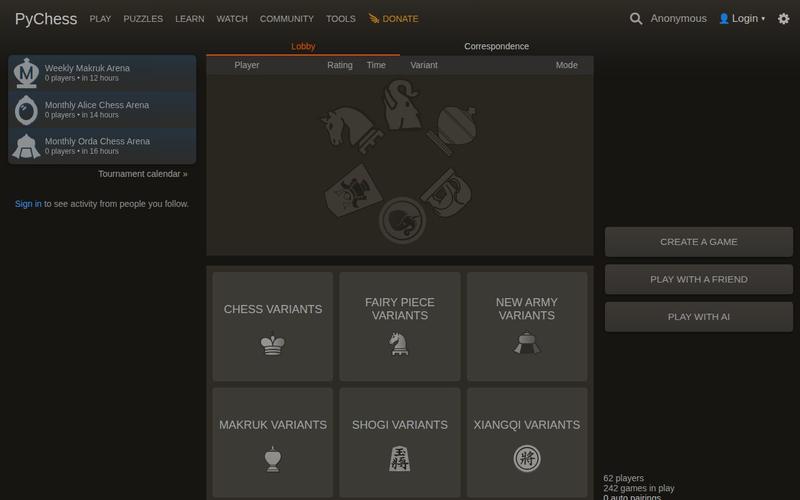
Join a weekly tournamentPyChess.orgpychess.orgThe PyChess lobby carries a Weekly Duck Chess Arena.Visit
Duck chess online: Chess.com and PyChess compared
Cost, sign-up, opponents, rating and phone play for each site in this directory that runs Duck chess, as of Nov 22, 2026.
Chess.com's reports on its Duck Chess Championships show how strong players use the duck. IM Nhat Minh To won the 2024 and 2025 finals, with IM Eric Rosen the runner-up both years. The points below come from those reports and from the inventor's page.
Block the defender, win the piece. The 2024 qualifier report shows White taking a knight with Qxd5 and putting the duck on e6, in front of the queen that guarded it: "You can snatch free pieces by blocking off their defender." Board 4 above is the same idea.
Trap a piece by taking its exit. The same report: "You can trap pieces by ducking off their escape route." Its example is 1.e5 with the duck on e7, which strands a bishop on f6.
Close the king's last square with the duck. In the same report, Bd4+ with the duck on h6 trapped a king that had one flight square. The 2024 final report calls smothered checkmate "a favored pattern in Duck Chess."
Respect knights. The 2024 qualifier report says knights, the piece the duck interferes with least, are "particularly dangerous in this variant." A duck can't block a knight's attack (board 5).
Take the square yourself. In the 2024 knockout, Rosen played 45...Ne5 with the duck on g4. By putting the duck there himself, the report says, he made sure his opponent's duck move couldn't go to that square.
Pins aren't absolute. In a 2024 qualifier, a rook seemed to pin a knight to the king, yet the knight jumped away with check and the duck blocked the rook. The report: "absolute pins are not so absolute."
Use the duck on your own king. The inventor's page says that if you leave your king attacked, you are "strongly advised to use your duck movement to block the attack."
PyChess's Play with AI form lists Duck among its variants, with an A.I. Level from 0 to 8 and a choice of real-time or correspondence games.
PyChess lists a Fairy-Stockfish bot in its lobby, and Fairy-Stockfish's own readme lists Duck chess among the variants it supports. A standard chess engine gives wrong advice here: it doesn't know about the duck.
Chess.com's help center says variants are currently web only and not supported in its mobile app, and it links an article titled "How do I play variants on the Chess.com app?"
PyChess is a website, so a phone browser can open its lobby.
Chess.com runs a Duck Chess Championship. IM Nhat Minh To won the 2024 final over IM Eric Rosen and, in 2025, won all four of his matches 3-0 and earned $750. The 2024 winner's prize was $600.
The 2025 qualifiers were open to players of all levels, and each was a 75-minute arena at 3+2. On PyChess, a Weekly Duck Chess Arena was listed in the lobby on Nov 22, 2026.
To play over the board you need two players, a standard chess set and one rubber duck small enough to sit on a single square.
Write each turn as move@square, such as Qxh7@g5, so you can replay the game later. After your move, pick the duck up and set it on a new empty square. Your opponent then moves a piece with the duck standing there.
Questions about Duck chess
What is Duck chess?
Duck chess is a chess variant invented in 2016 by Dr. Tim Paulden. Two players play standard chess with a shared rubber duck that blocks a square. After each move, the player must also move the duck to a different empty square.
How do you play Duck chess?
Make a normal chess move, then move the duck to an empty square. Pieces can't land on or pass through the duck, knights jump it, and there is no check. You win by capturing the king. Pick Duck chess as the variant when you start a game on Chess.com or PyChess.
Is there check or checkmate in Duck chess?
No. A move can leave your king attacked, and a king can step onto an attacked square. The game ends when a king is captured, so if yours is attacked, your move or your duck has to stop the capture.
Can the duck be captured, and can it stay where it is?
The duck can't be captured. It must move to a different empty square after every move, so it never stays put.
Can knights jump the duck?
Yes. A knight jumps over the duck like it jumps over any piece, but it can't land on the duck's square. The duck also can't block a knight's attack, which is why a knight check on a boxed-in king ends the game.
What happens in a Duck chess stalemate?
The player with no possible move wins. Chess.com's help article says "the stalemated player wins", and the inventor's rules call it fowling. It almost never happens, because a king can always step onto an attacked square.
Can you castle in Duck chess?
Yes. The king and rook must not have moved and the squares between them must be empty. Check rules don't apply, so the king can castle out of, through or into an attacked square.
Is Duck chess on Lichess?
The sites in this directory that run Duck chess are Chess.com and PyChess, so start with one of those.
Can you play Duck chess against the computer?
Yes, on PyChess: open Play with AI, choose Duck and set an A.I. Level from 0 to 8. PyChess lists a Fairy-Stockfish bot in its lobby, and Fairy-Stockfish's readme lists Duck chess among its supported variants.
Can you play Duck chess on a phone?
PyChess is a website, so a phone browser can open it. Chess.com's help center says variants are web only and not supported in its mobile app, and links an article on playing variants on a phone.
Who invented Duck chess?
Dr. Tim Paulden, president of Exeter Chess Club in Devon, England, invented it in early 2016. It spread in October 2022 after Chess.com added it and streamers played it.
Is there a Duck chess championship?
Yes. Chess.com holds one. IM Nhat Minh To won the 2024 and 2025 finals, with IM Eric Rosen the runner-up both years.