Chinese chess, or xiangqi, is a two-player game played on the points of a 9×10 board. Red moves first; checkmate the opposing general to win. Learn the pieces and the rules that catch chess players out, then choose a site for your first game.
Ready to play? Start with Xiangqi.com for people or computer opponents. The diagrams here explain the moves; the games open on the sites below.
Chinese chess rules and board setup
Set the pieces on the intersections, with Red at the bottom and Black at the top. The board has nine files and ten ranks. The river divides the two halves; each general and its advisors stay inside their own palace, a grid of nine points marked with diagonal lines.
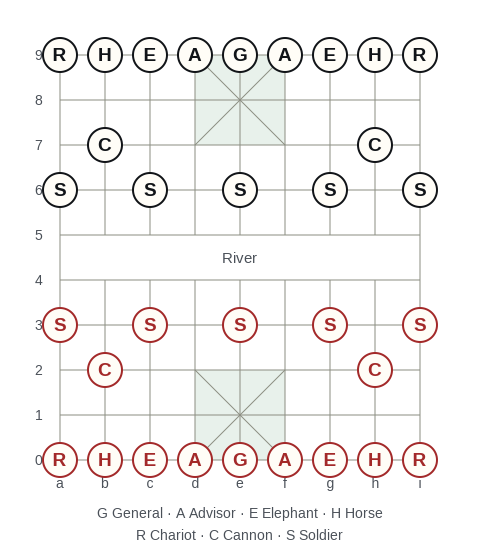
The starting position, with English piece initials
Read the diagram from Red's side. G is the general, A an advisor, E an elephant, H a horse, R a chariot, C a cannon and S a soldier. The shaded areas are the palaces. The letters a–i and ranks 0–9 are this guide's coordinates; many game records use a different notation.
Red moves toward rank 9; Black moves toward rank 0. Each side starts with 16 pieces.
Red makes one move, then Black makes one move. Capture by moving onto an enemy piece's point and removing it, following your piece's movement rule. You cannot land on a friendly piece or leave your own general attacked.
Each side starts with a general, two advisors, two elephants, two horses, two chariots, two cannons and five soldiers. On the back line, put chariot, horse, elephant, advisor, general, advisor, elephant, horse, chariot. The cannons stand two ranks forward on the horse files. The soldiers start another rank forward, on alternate files.
When in check, move the general, capture the attacker or stop its attack. A cannon check can also be stopped by removing its screen. Checkmate wins. Stalemate also wins for the player who leaves the opponent with no legal move, even if the general is not in check.
There is no castling, no initial two-step soldier move, no en passant and no promotion into another piece. A soldier that crosses the river gains sideways movement but stays a soldier.
Chinese chess pieces and how they move
Learn the chariot first: it moves like a rook. Then learn the cannon and the horse, whose restrictions make familiar-looking chess moves illegal. Characters differ between the two armies; the red and black versions of a piece follow the same movement rules.
General · G · 帥 / 將 One point horizontally or vertically, inside its own palace. It cannot move into check. The two generals must never face each other on an open file, even across the river.
Advisor · A · 仕 / 士 One point diagonally along the palace lines. It never leaves the palace; from its starting points it can reach only the corners and center.
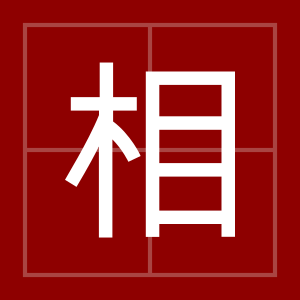
Elephant · E · 相 / 象 Exactly two points diagonally. The midpoint, called the elephant's eye, must be empty. It never crosses the river, so it remains a defender on its own half.
Horse · H · 傌 / 馬 One point straight, then one diagonally outward: an L-shaped move. A piece on the first straight point blocks that direction. Unlike a chess knight, it cannot jump that blocker.
Chariot · R · 俥 / 車 Any distance horizontally or vertically along a clear line, like a rook. It captures the first enemy piece on that line and cannot jump over anything.
Cannon · C · 炮 / 砲 Without capturing, it moves along clear ranks and files like a chariot. To capture, it must jump exactly one intervening piece of either color, called the screen. The screen stays on the board.
Soldier · S · 兵 / 卒 One point forward, including when capturing. After crossing the river, it can also move or capture one point sideways. It never moves backward, never captures diagonally and never promotes. On the last rank it can still move sideways.
Cannon screens, horse blocking and flying generals
These four examples isolate the moves most likely to surprise a chess player. Solid green arrows show legal moves; dashed lines ending in a cross show illegal moves. Unrelated pieces are left out so you can see the rule.
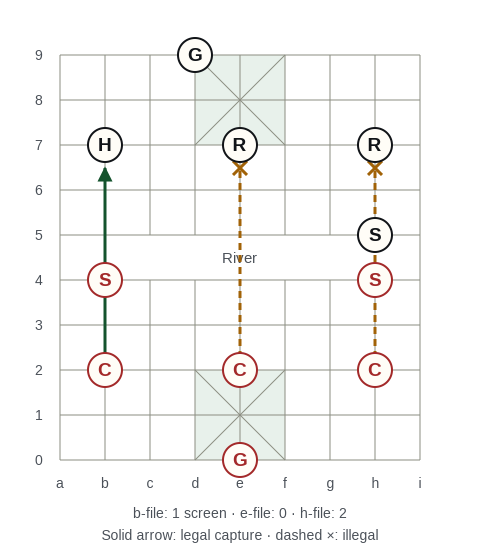
1. A cannon needs exactly one screen to capture
On the b-file, Red's cannon on b2 can capture the black horse on b7 because the soldier on b4 is the only piece between them. The soldier survives. On the e-file, the cannon cannot capture e7 because there is no screen. On the h-file, two screens make the capture illegal. An empty landing point never permits a jump: a non-capturing cannon move needs a clear path.
Count the pieces strictly between the cannon and its target: one works, zero or two do not.
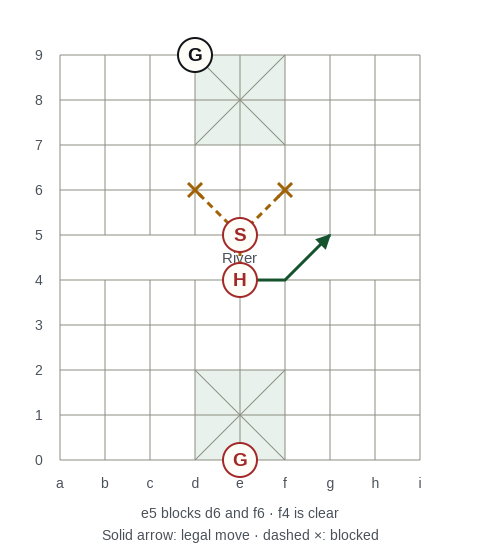
2. Block a horse's first step to stop its move
The red horse on e4 would normally reach d6 and f6. The soldier on e5 blocks its first step, so both destinations are unavailable. The route through f4 is clear, allowing e4–g5. Either army's piece can block a horse. Blocking e5 does not stop every horse move: check the first straight point for each direction separately.
The horse's leg is the first straight point, not the point it lands on.
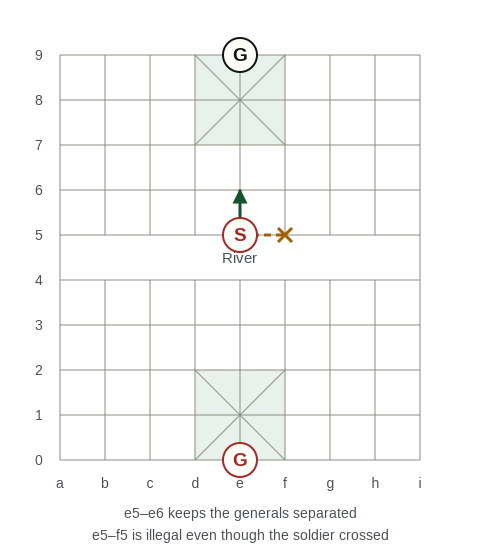
3. Moving a blocker can expose the flying generals
The generals on e0 and e9 share a file, but the red soldier on e5 separates them. Moving that soldier to f5 would uncover the file and is illegal. Moving it forward to e6 keeps the generals separated. This is the flying-general rule: do not treat a blocker as free to move just because neither general is nearby.
Before moving the last piece between the generals, look down the whole file.
4. The river stops elephants and strengthens soldiers
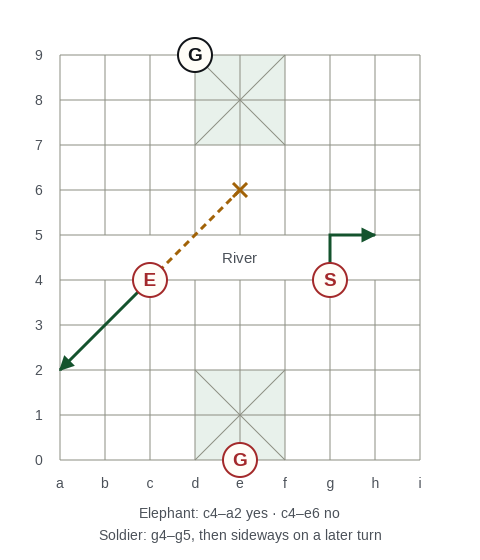
The red elephant on c4 can retreat to a2 through the empty point b3. It cannot go to e6: that would cross the river. Even on its own side, an occupied midpoint would stop it. The red soldier on g4 can advance to g5. Once there, on a later turn it can move sideways to h5 as well as forward to g6. It still cannot retreat to g4.
The river has no special restriction on a chariot, cannon or horse; follow that piece's normal move.
Choose where to play Chinese chess online
Your first gameXiangqi.comxiangqi.comChoose Play Computer, start at a low level and use graphical pieces if the characters are unfamiliar.Visit
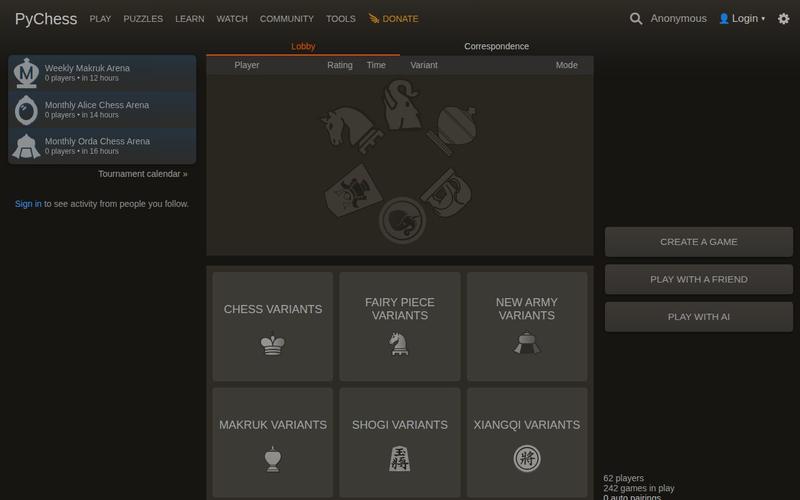
Rated games and other variantsPyChess.orgpychess.orgChoose Xiangqi from the game menu; the site also runs rated xiangqi events.Visit
Live or correspondence playPlayStrategyplaystrategy.orgIts xiangqi rules page links to game creation for rated or casual play.Visit
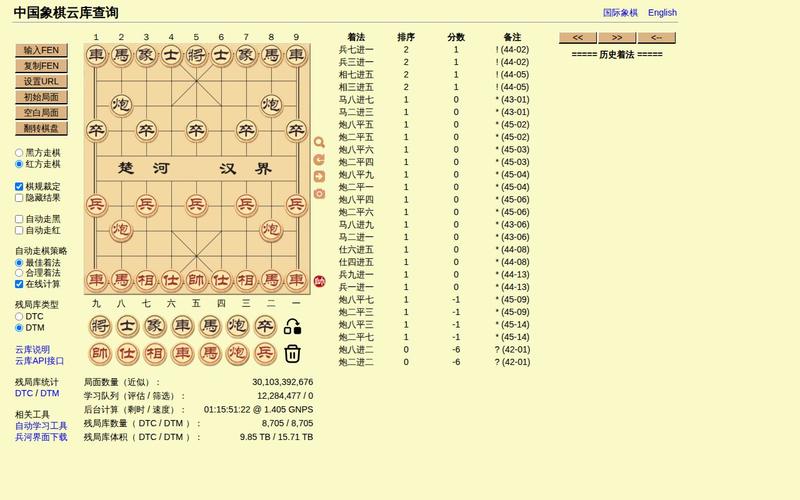
Analyze a positionChessDB.cnchessdb.cnEnter a xiangqi FEN or set up a position in the English query board.Visit
Compare Chinese chess sites: games and analysis
Three places for games, plus a position-analysis board. Browser options as of November 20, 2026. ChessDB is for analyzing positions, rather than finding a human opponent.
Develop your chariots, horses and cannons before chasing loose soldiers. Grandmaster Liu Dianzhong's opening principles, explained in English by Jim Png, emphasize active pieces, restricting the opponent and keeping your own pieces coordinated.
For your first games, choose a slower clock and aim to get every major piece into play. Afterward, return to the first position where you missed a screen or a blocked horse. Work out the legal alternatives before asking an analysis board for a move. A move you understand is easier to find again than a line you only memorized.
Open a line for a chariot. A chariot trapped behind its horse cannot use its range. Develop with a route in mind rather than spending several turns with one piece while the others stay at home.
Keep the horse's legs clear. A horse with blocked first steps looks developed but has few useful moves. When choosing a soldier advance, check which horse routes it opens for you and closes for the opponent.
Give the cannon a partner. A cannon needs screens. Before exchanging a piece on its file, check whether that piece is the only screen for an attack or the extra screen preventing one. The cannon example above shows both cases.
Learn one opening's plan. A central cannon moves toward the middle to pressure the central soldier; screen horses develop to support the center. Learn how your chariots join the position. Jim Png's guide, drawing on Grandmasters Zhao Xinxin and Liu Dianzhong and Master Huang Shaolong, recommends learning a practical opening deeply before collecting many unrelated lines.
Check threats before counting material. A tempting capture can lose if it opens your general's file, removes a defensive screen or lets a horse fork major pieces. Before each move, inspect checks, cannon lines, horse legs and the line between the generals.
Checkmate, stalemate and repeated checks in xiangqi
You win by checkmating or stalemating the opponent. Repeated checking is not a safe way to force a draw: xiangqi restricts perpetual checks and some repeated chases. Online servers apply their own repetition rules, so read the host's version before a rated game.
PlayStrategy explicitly uses a loss for perpetual checking after four repetitions, and a claimable draw on the fourth repetition of a position. Its rules page says chasing rules are not implemented in its engine. That differs from a full tournament ruleset and from the repetition limits described by Xiangqi.com. Do not carry the threefold-repetition draw rule from Western chess into every xiangqi game.
To answer a check, first identify the attacking piece. Against a chariot, block its line, capture it or move the general to safety. Against a cannon, count screens after your reply: removing the only screen can end the check. Every reply must also keep the generals from facing each other.
Xiangqi.com is the straightforward first stop: open Play Computer and start at the lowest level. Its homepage describes five difficulty levels. PyChess has a Play with AI option, and PlayStrategy also supports computer xiangqi. Choose a practice game before a rated human game if you are still learning the pieces.
Use graphical pieces if you cannot yet tell the Chinese characters apart. Take your time with cannon captures and horse moves. Computer difficulty labels are specific to each site; a level number on one host is not a comparable rating on another.
How to play Chinese chess online with another person
Choose a host, select Xiangqi and decide whether you want a rated or casual game. Set a slower clock while you learn, then join an opponent or use the host's friend-game option. On a multi-variant site, confirm that you selected Xiangqi rather than Mini Xiangqi or Janggi: their rules differ.
Xiangqi.com offers live two-player games and game review. PlayStrategy documents live and correspondence xiangqi; correspondence gives you longer to think between moves. PyChess runs xiangqi tournaments as well as ordinary challenges. A site offering anonymous browsing does not mean every rated or tournament feature works without signing in.
Chinese chess analysis and solvers
ChessDB.cn's English query board accepts a xiangqi FEN and lets you set up a position. It also has automatic-move controls. Use it to explore a position after a game; it is a different tool from a lobby that pairs two players.
A xiangqi position needs a xiangqi-aware tool. An ordinary Western-chess board has the wrong size, pieces and move rules. Check the side to move when entering FEN, and preserve the exact piece placement. Keep engine help for study and post-game review, rather than using it during a game against someone else.
Chinese chess is called xiangqi, written 象棋. You will also see the spelling xiang qi. It is a two-player game with generals, chariots, horses, elephants, advisors, cannons and soldiers.
How do you set up a Chinese chess board?
Put the pieces on the points. Each back line is chariot, horse, elephant, advisor, general, advisor, elephant, horse, chariot. Place the cannons two ranks forward on the horse files, and five soldiers one rank beyond them on alternate files. Mirror the arrangement for the other side.
How do you play Chinese chess?
Red moves first, then the players take turns moving one piece. Use each piece's movement rule to capture enemy pieces and attack the general. You must answer a check and cannot leave the generals facing across an open file. Checkmate or stalemate the opponent to win.
Where can I play Chinese chess online for free?
Xiangqi.com, PyChess and PlayStrategy offer free browser play. Choose Xiangqi.com for a dedicated xiangqi interface, PyChess for xiangqi alongside other variants, or PlayStrategy for live and correspondence games. Account requirements depend on the mode, especially rated games and tournaments.
Can I play Chinese chess against the computer?
Yes. Xiangqi.com's Play Computer page offers five difficulty levels. PyChess has a Play with AI option and PlayStrategy supports computer xiangqi. Start with a low level while learning legal moves; do not compare difficulty numbers across different sites.
Can two people play Chinese chess online?
Yes. Xiangqi.com, PyChess and PlayStrategy support games between people. Choose Xiangqi and a time control, then join a game or create a challenge. Casual play, a specific friend's invitation and a rated tournament are different modes, with different sign-in requirements.
Do I need to read Chinese to play xiangqi?
No. Xiangqi.com offers an English interface and graphical pieces. This guide uses English initials on its boards and gives the Chinese characters beside each piece name. Learn the movement rules first, then match the characters to the pieces as you play.
How do I win at Chinese chess?
Checkmate or stalemate the opposing general. For better chances, develop your chariots, keep your horses' first steps clear, coordinate cannons with screens and check your general's safety before every capture. Learn one practical opening's ideas and review the first mistake after each game.
Is there a Chinese chess solver or analysis board?
Yes. ChessDB.cn has an English xiangqi query board with FEN input, position setup and automatic-move controls. Enter the exact position and the correct side to move. Use analysis for study after a game; a solver is separate from a service that finds a human opponent.
What are the Chinese chess pieces worth?
Xiangqi.com's rough guide gives a chariot 9, a cannon 4 to 4.5, a horse 4 to 4.5, an advisor or elephant 2, and a soldier 1 before crossing the river or 2 afterward. Cannon and horse values change with the game phase. These are exchange guides; checkmate decides the game, not a point total.