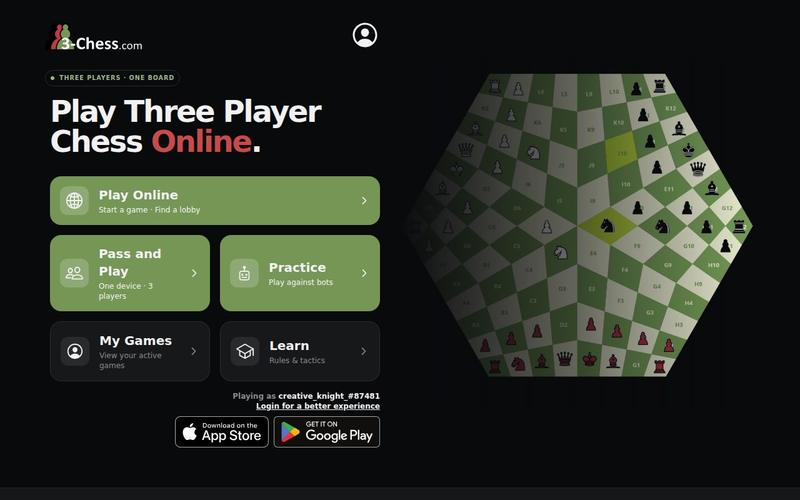
3 player chess: rules, board examples and online play
Three people, three full armies and one shared board. Learn the 96-square version, then start a free game with two friends or practice against bots on 3-chess.com.
These examples follow 3-chess.com's rules. Three-player chess has several versions: turn order, king capture and what happens after checkmate depend on the game you choose.
3 player chess rules: the 96-square board
On 3-chess.com, each player starts with a normal army of 16 pieces on one third of a six-sided board. The 96 spaces are four-sided cells, bent around a shared center called the rosette. A hexagonal board does not necessarily have hexagonal spaces.
Set up three armies. Each has a king, queen, two rooks, two bishops, two knights and eight pawns. The back pieces and pawn row occupy the two ranks nearest that player.
Take one turn each. The order here is White → Black → Red → White. You get one move, then both opponents move before your next turn.
Follow the board's lines. Rooks use ranks and files; bishops use diagonals; queens combine both. Lines bend on this board. Bishops crossing the center can choose between same-color diagonal routes. Knights still jump in an L, with extra possibilities near the center.
Move pawns away from home. Pawns move forward, capture diagonally and can advance two clear spaces on their first move. At the far end of an opponent's sector they promote. Across the rosette, a forward move follows its file rather than choosing any nearby space.
Keep your king safe from both rivals. On your turn, answer check by moving the king, taking the attacker or blocking its line when legal. Castling follows the usual unmoved-piece, clear-path and safe-king conditions. Checkmate eliminates a player; the survivors continue. The king-capture example below explains the turn-order exception.
These are teaching positions on the 3-chess.com board, with most pieces removed so you can see the move. Square names match that site's notation. Arrows show the move to consider; they are not extra turns or simultaneous moves.
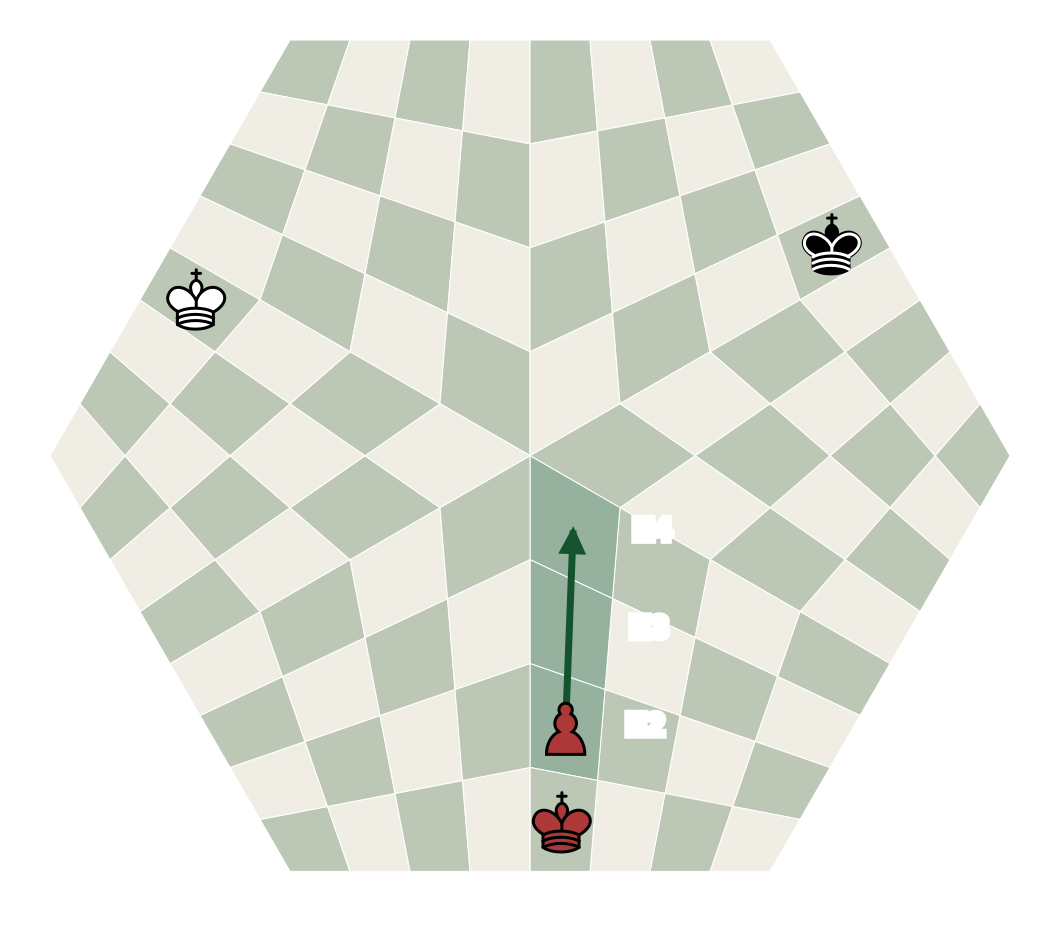
1. A pawn can advance two clear spaces on its first move
Red to move. The red pawn starts on E2. With E3 and E4 empty, E2–E4 is a legal first move. It cannot capture straight ahead: if an enemy occupied E3, even the one-space advance would be blocked.
Result: the red pawn reaches E4. White moves next, then Black, before Red moves again. Green marks the clear route.
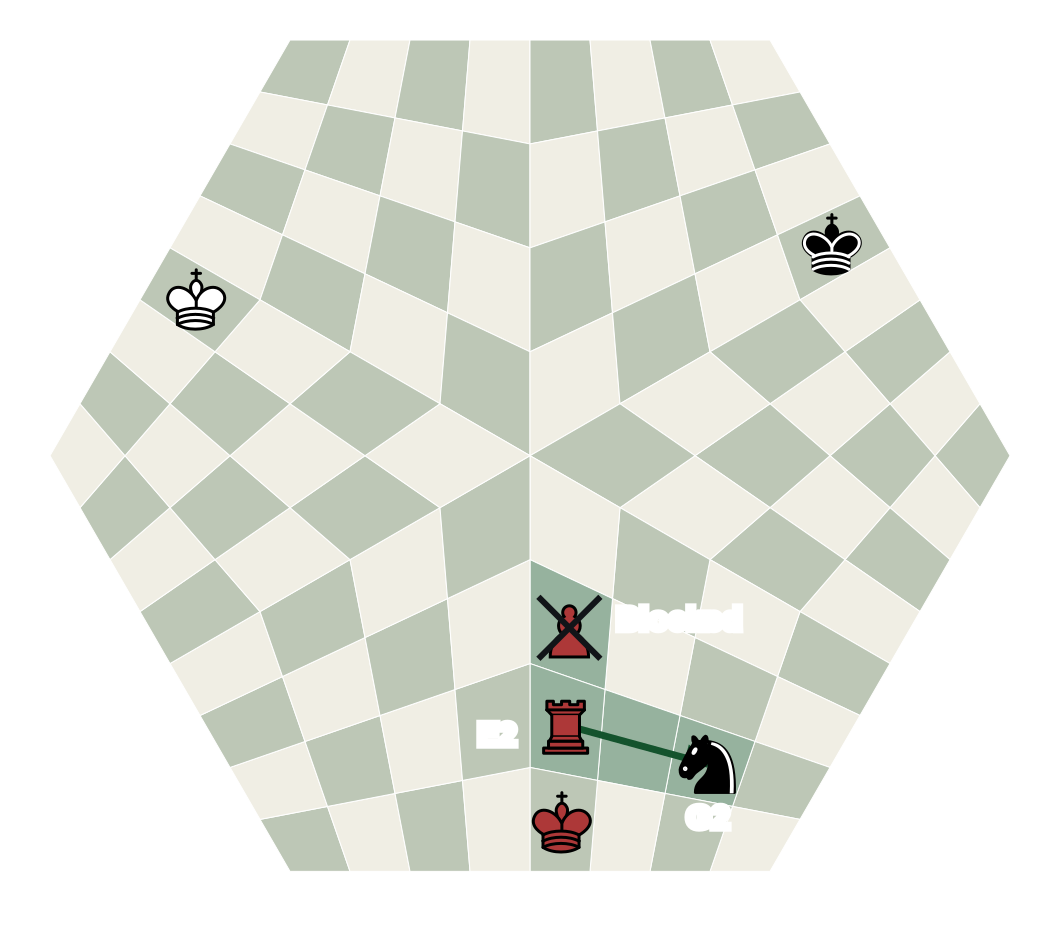
2. A rook can capture along a clear line, but cannot jump
Red to move. The rook on E2 can take the black knight on G2 because F2 is empty. It cannot move to E4: its own pawn on E3 blocks that file. A bent-looking line is still a rank or file when you follow the board's connections.
Result: E2×G2 takes the knight and leaves the red pawn on E3. The alternative E2–E4 is illegal because the rook cannot jump that pawn.
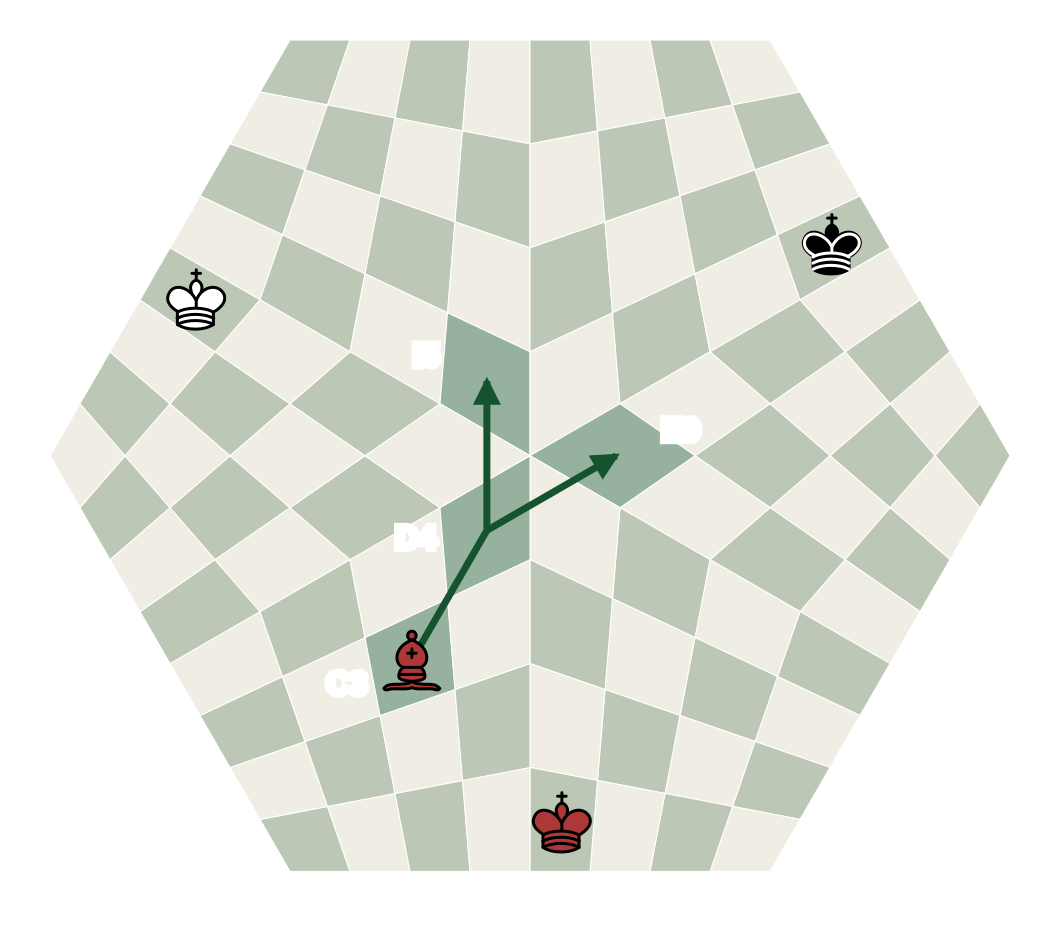
3. A bishop has a choice at the central rosette
Red to move. From C3 the bishop can travel through D4 and continue toward I5 or E9. Both destinations have the same square color as C3. Choose one route for this move; the bishop does not visit both branches or turn freely onto a different-colored cell.
Result: C3–I5 and C3–E9 are separate legal choices in this clear position. The rosette changes the route, not the bishop's square color.
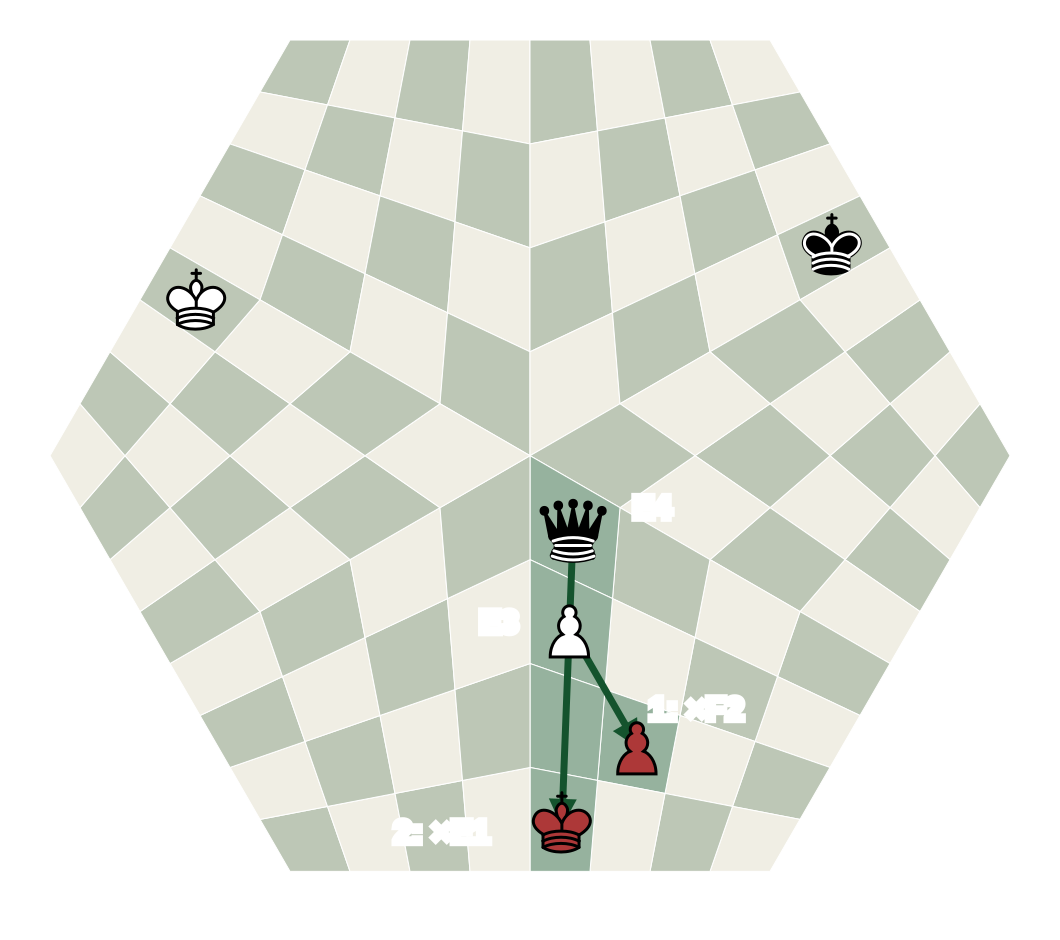
4. An opponent can capture a king before its next turn
White to move. Black's queen is on E4; a white pawn on E3 blocks its line to Red's king on E1. White plays E3×F2, taking a red pawn and opening the E-file. Black moves next, before Red, and can play queen E4×E1 to capture Red's king. This is allowed by 3-chess.com's rules.
Result: Red is eliminated before answering the discovered check. White and Black continue. This example does not apply to rulesets that prohibit capturing kings.
Three friends, separate devices3-chess.com3-chess.comStart New Lobby opens the friend-game route. Share its invitation so the others join your game.Visit
Three friends, one screen3-chess.com3-chess.comPass and Play puts all three players on one device. Take White, Black and Red in turn.Visit
One player, two computer opponents3-chess.com3-chess.comPractice with Bots supplies both opponents. Bots can also fill empty seats in a lobby.Visit
Compare ways to play three-player chess
3-chess.com offers all three modes: online friends, one-device pass-and-play and computer practice. Browser play is free. Options as of Nov 20, 2026.
Checkmate, elimination and other three-player rulesets
Agree on the ending before the first move. The same-looking board does not guarantee the same game: some versions stop at the first checkmate; others eliminate players until one wins.
3-chess.com's 96-square version. Checkmate or the permitted king capture eliminates a player. Their remaining pieces stay on the board and stop moving. With three still playing, a stalemated player skips their turn; with two left, stalemate draws the game. Follow the detailed rules rather than treating every stalemate as a draw.
First-checkmate versions. Some three-player rules end the entire game on the first mate. Then being the player who gives mate matters more than surviving for a later duel. Do not import that victory condition into a last-player-standing game.
Army removal or transfer. Other versions remove a defeated army or give it to the player who defeated it. That changes open lines and the balance of material immediately. A frozen army, a removed army and an inherited army are different rules, not interchangeable descriptions.
Circular three-player chess. A round board with moats and creeks uses different movement restrictions. These six-sided board diagrams do not teach those boundary rules. Use the instructions supplied with that particular board.
Calculate both opponents' replies before committing to a capture. Your first target is only half the problem: the other player gets a move before you can repair your position.
99Matthew99's free-for-all guide emphasizes development, two attackers coordinating threats, and keeping enough material for the final duel. It is written for four-player chess; the advice below adapts those principles to three. Its opposite-partner plans and point-scoring tactics do not carry over to this hexagonal game.
Develop while protecting both sides. Bring pieces into play without leaving loose targets for the opponent you are not attacking.
Read the turn order with every check. In the king-capture example, Black acts before Red can respond. Count that intervening turn in every forcing line.
Treat two threats as a joint problem. A check from one rival can cost you time to save a piece from the other. Defend before both attacks arrive.
Trade for a reason. An equal exchange with one opponent reduces both armies while the third keeps their material. Ask who benefits from the resulting duel.
Reassess after every elimination. The last-player-standing game becomes a duel, but frozen pieces still block routes. Recount the attackers rather than assuming you have reached a normal chess endgame.
Practice with Bots on 3-chess.com gives you two computer opponents without waiting for other people. Start with the easier setting while you learn the central squares. For a mixed game with a friend, bots can fill empty lobby seats.
For movement practice, Freeplay lets you move pieces without taking normal turns. It is a teaching sandbox, so use Practice with Bots when you want opponents that answer your moves.
Yes. Three-player variants give each person an army and a turn on a shared board. The version explained here uses a six-sided board with 96 four-sided cells and three normal armies. It is a separate game from standard two-player chess.
How do you set up a 3 player chess board?
For this 96-square version, place each army in its own eight-file home area: eight back-rank pieces and eight pawns in front. Each player has 16 pieces. Online, the site sets them up for you; a physical board needs the setup diagram for its own version.
How do bishops move through the center?
On 3-chess.com, a bishop follows a diagonal of its starting square color. At the central rosette it can choose between continuing diagonal routes. In example 3, C3 through D4 can continue toward I5 or E9. It cannot turn onto an arbitrary neighboring square.
Can a king be captured in 3 player chess?
Yes in 3-chess.com's particular rules. If White exposes Red's king to Black's queen, Black can capture it before Red's next turn. Example 4 shows the sequence. Other rulesets prohibit king capture, so agree on the version before playing.
Does the first checkmate win?
It depends on the ruleset. On 3-chess.com, checkmate eliminates that player and the survivors continue until one wins. Other three-player games end at the first checkmate. The board shape alone does not tell you which victory rule applies.
What happens to an eliminated player's pieces?
On 3-chess.com, the defeated army remains on the board and can no longer move. Do not remove it or hand it to the winner unless your chosen version explicitly uses that rule. Whether inactive pieces can be captured is another rule to confirm before a physical game.
What happens on stalemate?
On 3-chess.com, a player with no legal move who is not in check skips their turn while all three players remain. With only two left, stalemate ends the game in a draw. Other variants use different outcomes.
Can I play 3 player chess against the computer?
Yes. Open Practice with Bots on 3-chess.com to face computer opponents. You can also add a bot to an online lobby if you have one friend instead of two. Freeplay is a separate movement sandbox, without normal turns.
Can we play 3 player chess online for free?
Yes. 3-chess.com offers free browser play and says no account is required to start. Choose Play Online, then Start New Lobby for a friend game. For three people sharing a device, choose Pass and Play instead.
Is three-check the same as three-player chess?
No. Three-check is a two-player game where giving your opponent three checks wins. Three-player chess has three people controlling three armies. A site advertising three-check is not, by that fact, offering a game for three people.